Posts

Lesson Planning - Technology Edition!

Image
  W e can't say that technology has never been used before in the classroom or during lesson planning, but, since the online school replaced the real-life one, teachers and students have been getting themselves more and more familiar with all the possibilities and tools technology has to offer. Starting from, of course, digital devices, and moving on to programs and apps that serve for a specific purpose or just make everything easier and more interactive.  Starting from the most helpful and obvious technology tool, search engines such as Google, Bing or Yahoo, which provide numerous helpful apps, such as translators, docs, books, forms, sheets, and so on; then moving on to video platforms such as YouTube or Dailymotion, then moving on to general or specific apps and websites. The shift to remote learning had many teachers scrambling to find effective ways to share lessons, deliver instruction, and allow students to collaborate. Here are some of our favourite tools, divid...

Cooperative Learning

Image
  Can you guess from the name what Cooperative Learning is about?  In this approach, also named as Collaborative Learning, students work on a task in groups and often are rewarded either partially or completely for the success of the group as a whole. Aspects of cooperative learning have been part of education for a long time; some form of cooperation has always been necessary to participate on teams.  he more active a lesson, the more students tend to engage intellectually and emotionally in the learning activities.  The use of cooperative learning groups in instruction is based on the principle of constructivism, with particular attention to the contribution that social interaction can make.   In essence, constructivism rests on the idea that individuals learn through building their own knowledge, connecting new ideas and experiences to existing knowledge and experiences to form new or enhanced understanding.  The core element of cooperative learning...

Multiple Intelligences - Gardner's Theory

Image
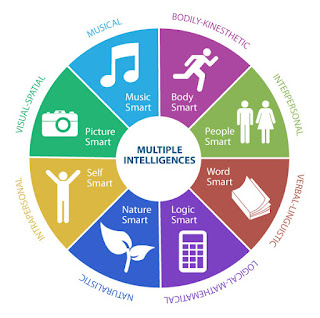
What does "Multiple Intelligences" mean?  All of us discover at one point in our life, whether it is in an early age or during growth, that we are better at some things than others. As we grow and learn, we gain new skills and work on assigned skills, usually from school, society of family, but this happens to all of us: while we try to be great at everything, we realise that we don't perform the same in every skill. Maybe we are great at writing and vocabulary, but struggle with mathematics. Or maybe you are good at visualizing and designing but perform poorly in sports and physical activities. Everything happens because of... multiple intelligences! So, what exactly does Gardner say about this?  Howard Gardner's theory of multiple intelligences proposes that people are not born with all of the intelligence they will ever have. Meaning that, w hile a person might be particularly strong in a specific area, such as musical intelligence, he or she most likely possesses ...

High-tech Education?

Image
  Technology in education , technology in the classroom... it all used to sound like some fun activity we would do in one special class, but these days it has gained a new importance. A pandemic struck the globe and online classes and use of technology are conditioned. Oh, the day has finally come. High-tech education? The good news? It is instant, saves time, it is practical. The bad news? More than half don't know how to use it.    Let's admit it: no matter how prevalent technology has become over these last few years, and specifically during the pandemic, not everyone is a big fan of it. Young people, despite using social media and the internet most of the day, complain about how difficult it is to use educational and practical programs. Technology has been created to make our lives easier, not harder, so we shouldn't close our eyes to it and assume that it is hard or too demanding, but instead embrace the idea of learning useful technology skills that will help in sim...